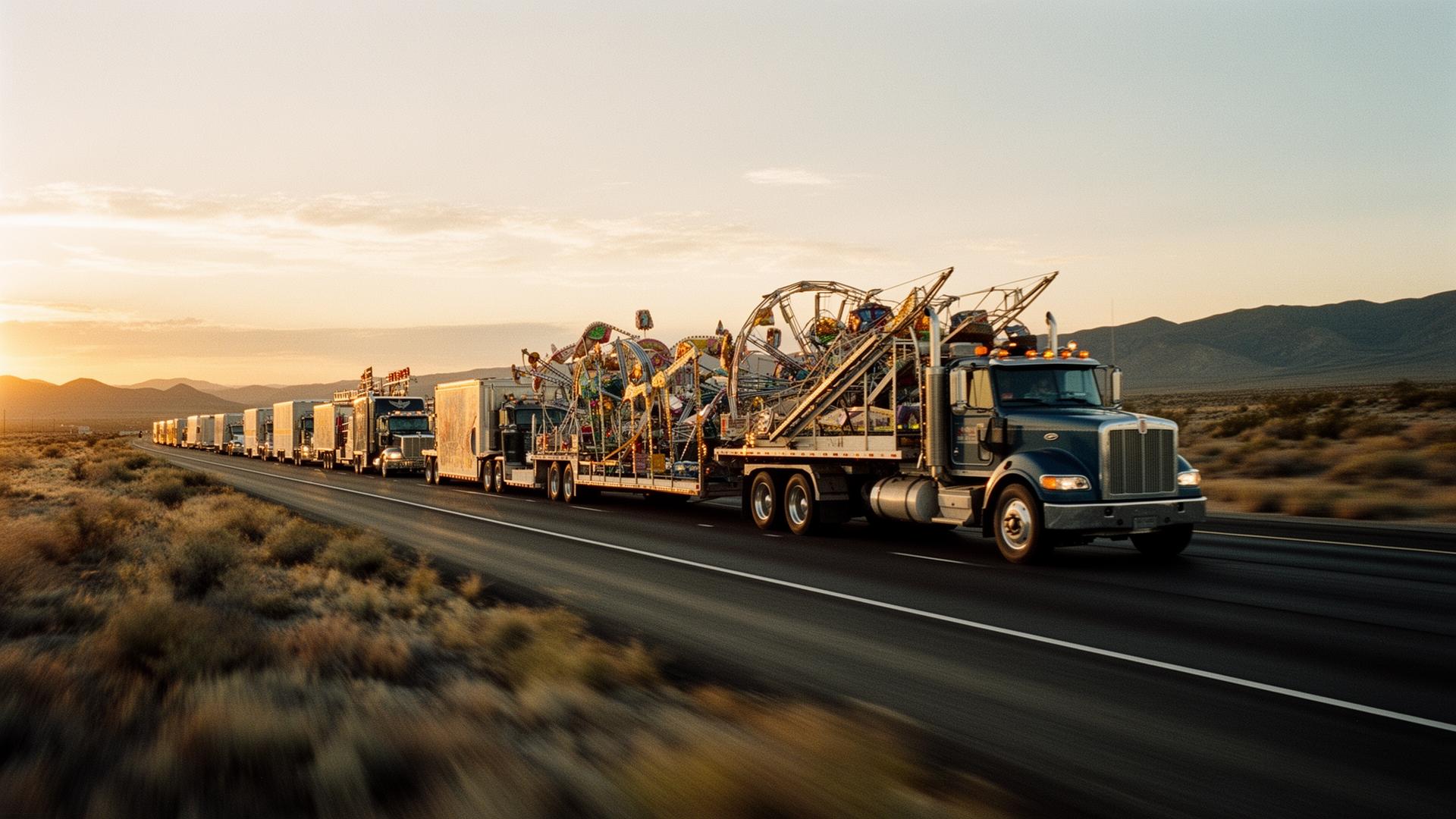
A convoy of brightly painted carnival trucks driving down an American highway at sunrise
← Carnival Career
Life On The Road

A New Town Every Monday.

A traveling carnival hits 30 to 40 spots a year. You wake up Tuesday in a parking lot in Ohio, and by Sunday night you are packing to drive to Indiana. You will cross more state lines in one season than most people do in a decade. Here is exactly how that works, what the move looks like, and what it is like to live a life where your address changes every seven days.

01

The jump

Sunday night, after the last ride shuts down and the last guest leaves the midway, the entire show begins to tear down. Within four to six hours, a fairground full of rides, games, food stands, and lights becomes a parking lot of trailers ready to roll. By Monday morning, a convoy of 25 to 60 trucks is on the interstate, headed to the next town.

CDL drivers pull the big loads — rides, generator trailers, bunkhouse trucks, office trailers. Everyone else rides in the bunkhouse trucks, follows in personal vehicles, or sometimes hops a ride in a tractor's sleeper cab. You eat at truck stops, you nap when you can, and by Monday afternoon the convoy is rolling into the next fairgrounds, where setup starts almost immediately.

02

The route

Most shows run a fixed circuit — the same fairgrounds in the same order, year after year. The route is the show's most valuable asset, built up over decades of contracts with fair boards, churches, shopping centers, and city festivals. You will know in March exactly where you will be the week of July 4th. That predictability is one of the best things about the job.

Big shows cover 8 to 12 states a season, often a full coast or a regional loop. Smaller shows stay close to home, working a 200-mile radius all summer. The route maps to the calendar — spot dates in spring, county fairs through midsummer, state fairs in the fall. By the end of October the show is headed back to winter quarters, usually in Florida, Texas, or the Gulf Coast.

  • Spring (March–May): small spot dates, church festivals, school carnivals
  • Summer (June–August): the bread-and-butter county fairs
  • Fall (September–October): state fairs, the biggest paydays of the year
  • Winter (November–February): winter quarters maintenance or off-season

03

How you get there

If you do not own a car, the show is your transportation. Most shows have a bunkhouse truck that doubles as worker transport between spots. You toss your duffel in your bunk, climb in, and ride. You do not pay for fuel, you do not deal with insurance, you do not worry about breakdowns. The show handles all of it.

If you do own a car, you can follow the convoy at your own pace. Some workers prefer this because it gives them flexibility — they can take a longer break on jump days, stop to see family along the route, or detour for a visit to a town they have always wanted to see. Either way works. Most first-year workers ride with the show and only buy a personal vehicle once they are sure they want to stay.

04

What you actually pack

One duffel bag. That is it. Anything more and you will regret it the first time you have to move it. Inside the duffel: three pairs of jeans or work pants, six or seven shirts you do not mind ruining, a hoodie, a rain jacket, work boots and a backup pair, a hat, sunglasses, work gloves, toiletries, a phone charger, a power strip, and a padlock for your bunk locker.

Smart workers also bring a small first-aid kit, throat lozenges, sunscreen, a refillable water bottle, ear plugs for sleeping near the bunkhouse generator, and a paperback book or two for slow afternoons. Skip the expensive clothes, the big speaker, the laptop stand, anything fragile. The road is hard on stuff. Bring what you can replace at a Walmart for $20.

05

Setting up in a new town

Monday afternoon the convoy rolls into the fairgrounds. The foreman has a printed setup map showing exactly where every ride, game, and food stand goes. You unload your assigned piece — a ride, a joint, a generator — and you start building. Setup runs from Monday afternoon through Tuesday afternoon for most shows, sometimes longer for the bigger state fairs.

Each spot is different. Some fairgrounds have flat asphalt and full electrical hookups. Others are bumpy grass with one power source and a single water spigot. The veterans know every quirk of every fairground on the route — which gate the trucks unload from, which lot the bunkhouses park in, where the cook tent goes, which hotel down the road has $59 rooms for the workers who occasionally want a real shower.

I've been to 41 states. Worked the Texas State Fair, the Big E in Massachusetts, the Minnesota State Fair. Most truckers haven't seen what I've seen.

Reggie, 11 seasons

06

Seeing the country, sort of

You will cross more state lines in one season than most people see in a decade. By season's end you will have been to small towns in Oklahoma, fairgrounds in Iowa, the boardwalk in New Jersey, the panhandle of Florida, the Texas hill country, and a hundred places you would never have visited otherwise. You will see the back side of America — the truck stops, the laundromats, the family-owned diners that have been open for sixty years.

But you will see it from a fairground, not a tourist map. The trick is using your one day off, usually Monday, to actually walk into the town you are parked next to. Find a coffee shop downtown. Visit the local museum. Take a picture by the courthouse. Workers who do this come home from a season with stories. Workers who never leave the bunkhouse just come home tired.

07

Connecting with locals

Every fair has its own community. 4-H kids selling lemonade, livestock farmers showing cattle, local rotary club members running the gate, high schoolers working concessions. Most of them have never met a carnival worker before. Smile at them, answer their questions, treat them like the neighbors they are. The reputation of the entire carnival industry rides on small daily interactions.

Many veteran workers have friends in towns all over their route. They get invited to weddings, graduations, post-fair barbecues. A traveling life does not mean a lonely life — it means a network spread across an entire country instead of concentrated in one zip code. Some workers consider their road family closer than the relatives they grew up with.

08

Distance, distance, distance

The longest jumps on a typical route are 400 to 600 miles, sometimes more. That is a one-day haul for a CDL driver. The shortest are 30 miles, when the show moves from one small spot to another in the same county. Average week-to-week jump is around 200 miles, which is a comfortable Monday morning drive that puts you in the next town with daylight to spare for setup.

Fuel costs are on the show, not you. The convoy is logistically complex — fuel cards, scale tickets, route permits for oversize loads, hotel reservations for the drivers, food for the crew. None of that is your problem. You ride, you arrive, you set up, you work. The complexity is the show's job; the work is yours.

09

Border weeks and special routes

A few shows run routes that cross national borders. Some go into Canada for the summer fair circuit in Alberta or Ontario. Others run shows along the Mexican border. International routes require passports, sometimes work permits, and a higher level of documentation. They also pay better because the talent pool is smaller. If you have a passport and a clean record, ask about cross-border opportunities your second or third season.

Most workers stay domestic for their first year. The US route is varied enough that you will see more in a single season than most people see in a lifetime. Save the international stuff for once you have your bearings.

10

The travel itself becomes home

By the end of your first season, the road stops feeling like travel and starts feeling like home. You will know the rhythm of the jump — the late Sunday teardown, the early Monday drive, the Tuesday setup, the building Wednesday, the packed Friday and Saturday, the winding-down Sunday. You will know which truck stops have the best coffee. You will know which fairgrounds have the cleanest showers.

That sense of belonging to a moving thing is something most people never experience. You are not stuck. You are not bored. You are not staring at the same four walls every night. The country becomes your backyard, the show becomes your family, and the rhythm of the jump becomes the heartbeat you measure your year by. That is what the lifers mean when they say they could never go back to a regular job.

The Takeaway

The road is a lifestyle, not a hardship.

If the idea of a new town every Monday excites you, this job is going to feel like freedom from the first jump. If it terrifies you, you will know within two or three weeks. Either answer is fine — but the only way to find out is to be on a truck when one rolls out. Most workers who try it for one season end up staying for several.

Ready to hit the road?

One 60-second AI interview. No resume. Housing covered.

Apply in 60 Seconds