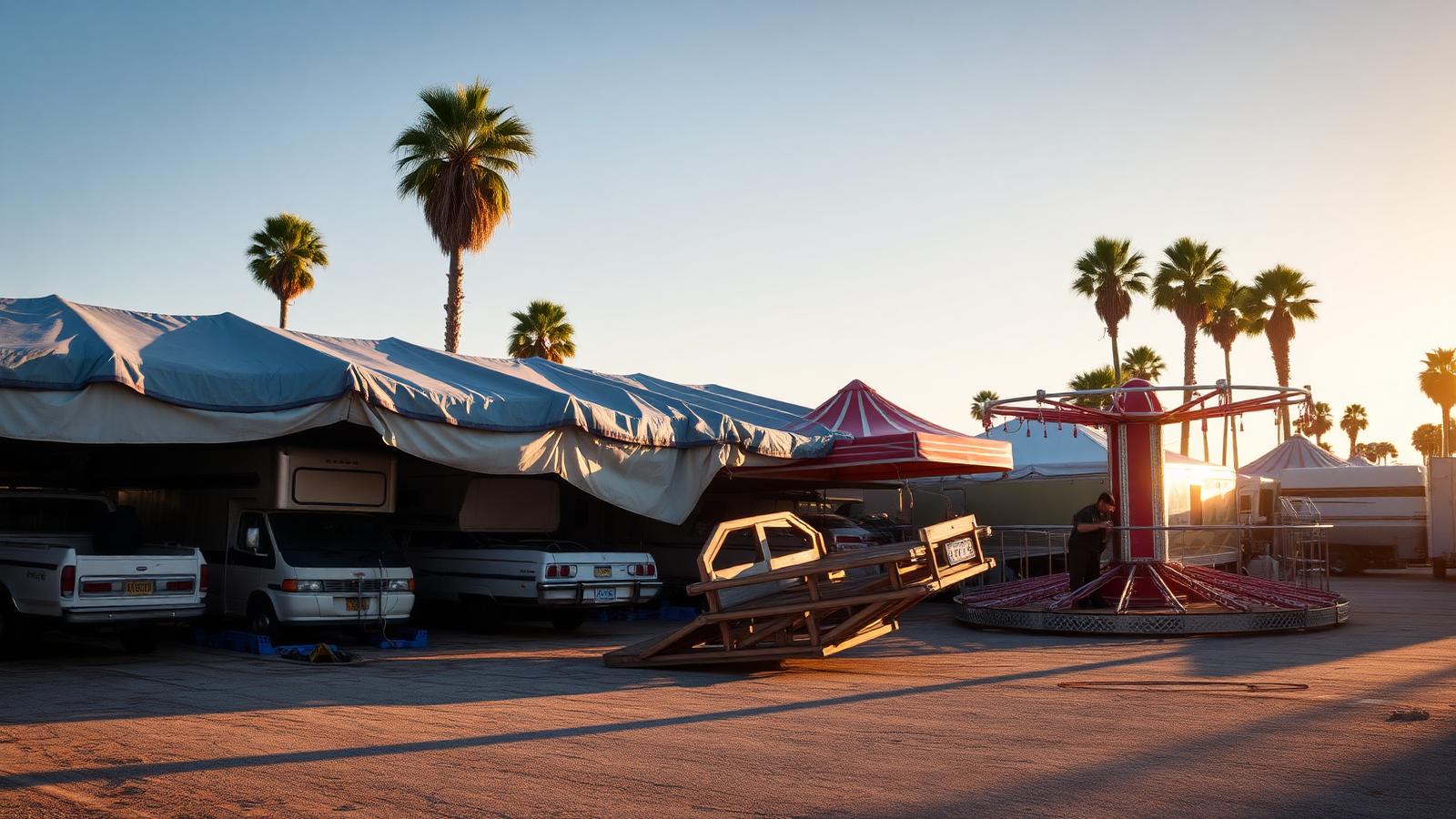
A carnival in winter quarters with rides parked under tarps and a mechanic working in afternoon sun
← Carnival Career
The Calendar

It's Seasonal. Here's How It Works.

The carnival is not a year-round job, and that is a feature, not a bug. Most shows run roughly March through October — about 32 to 38 weeks of paid road work, depending on the route. The smart workers plan around the off-season instead of being surprised by it. Here is exactly how the year breaks down and how to turn a seasonal job into a full year of money and life.

01

The standard season at a glance

Spring training starts in February for most shows, almost always in Florida or Texas. Rides come out of winter storage, get inspected and rebuilt, and the crew starts arriving for early-season shakedown. By mid-March or early April most shows are running their first paid spot dates. Through April and May, the calendar fills out with church festivals and small county fairs.

Peak summer runs from mid-June through Labor Day weekend. This is when the route is at its most intense — back-to-back county fairs, longer runs, bigger crowds, biggest middle-of-the-season paychecks. After Labor Day the calendar pivots into state fair season, which runs through October. By Halloween, most rides are headed back to winter quarters for the off-season.

02

Why a seasonal schedule is good for workers

Eight months of intense, well-paid work followed by four months to actually live your life. Hunting season. Time with family. School. Side jobs. A vacation that lasts longer than a long weekend. A lot of carnival workers consider the seasonal structure to be the best part of the job — not a problem to solve but a deliberate way to live.

Compare it to a year-round 9-to-5 with two weeks of PTO. Carnival workers get the equivalent of a full season off every single year, with nothing to ask permission for. They earn during the work months and rest during the off-months. The structure is closer to how teachers, commercial fishermen, and pro athletes live than how most office workers do.

  • Stack real money during the peak fair months
  • Take a real four-month break, not a two-week vacation
  • Use the off-season for family, hobbies, school, or side work
  • Come back fresh every spring instead of burning out

03

Winter quarters — staying on payroll year round

Most shows park in Florida, Texas, or the Gulf Coast for the winter. The yard is a fenced lot where the trucks, rides, and trailers spend the off-season. There is always maintenance to do — rebuilding rides, repainting cars, repairing trailers, restitching canvas, electrical and hydraulic overhauls.

Most shows hire a small winter quarters crew of 5 to 15 workers to handle this. The work is steady, the pay is lower than fair weeks (usually $400 to $700 a week with housing still covered), and the pace is much calmer. If you want year-round pay and free housing without ever leaving the show, ask your foreman in September about staying on for winter work.

04

Side gigs and off-season work

The other common pattern is to do something different during the off-season. Construction crews love hiring carnival mechanics and foremen because the skills overlap perfectly. Warehouse and logistics companies hire for the holiday peak from November to January. Some workers do farm work, ranch work, hunting guide work, or short-term oil field work.

Holiday retail — Amazon, UPS, FedEx, big-box stores — needs thousands of seasonal workers from late October through January, which aligns perfectly with the carnival off-season. A lot of workers stack a full carnival season with a holiday retail or warehouse stretch and clear $50,000+ for the year combined.

05

The school path

Some workers use the off-season for school. Community college classes from November through February work neatly with the carnival schedule. Trade school programs in welding, HVAC, electrical, or diesel mechanics are especially valuable because they directly increase your earning power on the show. A worker with a welding cert can pull $25 to $40 an hour on side jobs in the winter or jump to $1,500-plus weeks on the show.

Online programs are even more flexible. Many workers take online classes through the season using bunkhouse WiFi and finish degrees over several years. The seasonal structure actually makes school easier, not harder, because you can take a heavy course load November to February when you have time and a lighter or no load during fair season.

I make $40K in eight months and spend the winter deer hunting and watching my kids' school plays. I'm not going back to a year-round 9-to-5.

Mike, 5 seasons

06

Saving in season

The single biggest financial mistake new workers make is treating off-season like a surprise. November hits, the paychecks stop, and they have not saved anything. Suddenly the freedom of seasonal work becomes the stress of seasonal work, and that is when people quit the industry.

Veterans avoid this by automating savings from week one. Most banks let you set up an auto-transfer that moves a fixed amount from checking to savings on a schedule. Set it for the day your check hits. Move 30 to 50 percent of every paycheck into savings during fair season. Live on the rest. By November you have a cushion that covers your off-season without panic, and you go into the winter with options instead of pressure.

07

Health insurance and benefits

Health insurance is a real question for seasonal workers. Some larger shows offer group health coverage for full-time workers. Others do not. If you do not have employer coverage, the federal marketplace at HealthCare.gov sells individual plans that are subsidized based on your income — which, given the seasonal nature, often comes out very affordable.

Workers comp coverage is provided by every legitimate show during the work season. Make sure you understand what is covered and how to report an injury. If you get hurt on the job during a fair week, you have protection. That is part of why working with an established show matters more than chasing the highest weekly rate from a fly-by-night operation.

08

Planning the off-season early

The workers who do well plan their off-season in August, not November. By Labor Day you should know roughly what you are doing for the next four months — whether that is winter quarters work, a specific seasonal job, school enrollment, or a structured break with family. A specific plan removes the anxiety that derails a lot of workers in October.

The plan does not have to be ambitious. "I am going home, working part-time at the warehouse, taking two classes, and seeing my kids every week" is a great plan. "I am going to figure it out when I get there" is the plan that lands a lot of workers in trouble. Sketch the four months in August and you will have a much smoother fall transition.

09

Returning the next spring

Carnival shows want their good workers back. Most shows do exit interviews in October to lock in commitments for the following spring. If you had a good season and showed up sober and reliable, your foreman will want to see you in February for spring training in Florida or Texas.

The commitment is not legal — you can change your mind — but it is reputational. Workers who come back season after season build a reputation that opens doors to better rides, better joints, foreman positions, and eventually management. The carnival industry is small enough that reputations travel between shows. A worker known to come back reliable and ready is one of the most valuable people in the business.

10

Annual income from a seasonal job

Here is the math that surprises people. A first-year ride worker who shows up sober and completes the season clears $25,000 to $35,000 with almost no living expenses. A second-year operator with a few certifications clears $40,000 to $55,000. A foreman or strong game agent clears $55,000 to $80,000 for the season. All from 32 to 38 weeks of work.

Add a winter side gig — even $400 a week for ten weeks — and you are at $30,000+ for a green worker and $60,000+ for a veteran, with no rent paid the entire year. That is annual income comparable to a salaried job for half the actual time worked, plus the ability to take a four-month break. The math is the math. Seasonal does not mean less money. It means the money is concentrated, and the rest is freedom.

The Takeaway

Seasonal is a feature, not a flaw.

The smart workers treat the seasonal calendar as a financial structure to plan around, not a hardship to endure. Eight months of focused work, four months of real life. Save during the season, rest in the winter, come back fresh in the spring. That rhythm is one of the most underrated parts of this entire industry.

Ready to hit the road?

One 60-second AI interview. No resume. Housing covered.

Apply in 60 Seconds