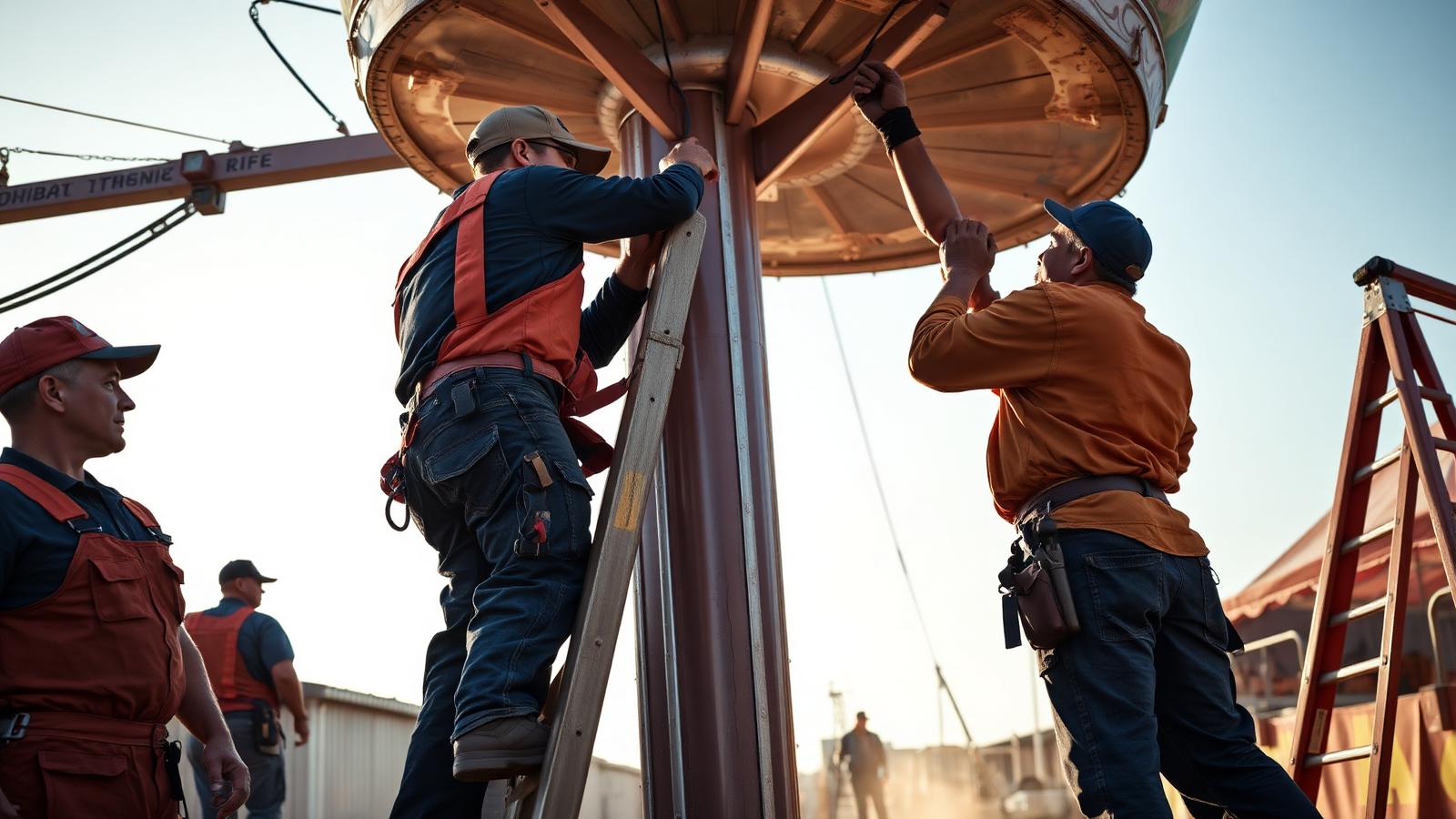
Carnival ride crew assembling a spinning ride during morning setup
← Carnival Career
Ride Crew

Working On The Rides.

Bolting steel at 6am, running a Tornado at midnight, tearing the whole thing down by 3am Monday. Ride work is the backbone of every traveling carnival, the fastest path from green hire to foreman, and the most respected job on the midway. Here is the complete picture — setup, operations, safety, teardown, and how to build a real career from it.

01

Setup day

You arrive Sunday or Monday afternoon. The trucks are already there. The foreman walks you through your assigned piece — say, the Tornado or the Zipper — and you start with hand tools, hydraulics, and a lot of yelling over engines. Most spinning rides come together in 4 to 8 hours with a crew of three to six.

The build is methodical. You unfold the base, level it with hydraulic jacks, raise the center mast, attach the arms, connect the cars, run the electrical, and pressure-test the hydraulic system. Every step has a checklist. A foreman or senior mechanic signs off on each phase. By the time the inspector arrives the next morning, your ride should be standing ready to test.

02

Daily safety check

Before the gates open every single day, you do a walkaround. You climb on the ride. You check every bolt visible from the platform. You inspect the restraints — every lap bar, every shoulder harness, every seatbelt. You cycle the ride three times empty to confirm the cycle time is right and nothing sounds wrong. You sign the daily inspection log.

This is the most important fifteen minutes of your day. The inspector can show up unannounced and ask to see the log. More importantly, this is how nobody gets hurt. A bolt that worked itself loose overnight, a hydraulic line that started seeping, a sensor that misfires — you catch these in the walkaround or they catch you later in front of a crowd. Veterans never skip it. Neither will you.

03

Operating during the run

Once the inspector signs off and gates open, you are running it. Buckling kids in, double-checking restraints on every single cycle, pushing the start button, watching the cycle, stopping for any anomaly. You will learn one ride deep, then a second, then a third. Operators certified on multiple rides are paid more, get scheduled more, and have more bargaining power for the next season.

The job is not just pushing buttons. You are watching the crowd, watching the platform, watching the ride for any unusual sound or motion. You are the last line of defense for guest safety. A good operator can spot a kid trying to slip out of a harness, a stalled gear, or a hydraulic glitch before they become a problem.

  • Restraint check on every single cycle — no exceptions
  • Eyes on the platform, not the phone, not the crowd
  • Know your e-stop and use it without hesitation if anything looks wrong
  • Daily log signed and filed before gates open

04

Reading guests on the platform

Most ride safety issues are about people, not machines. A toddler too small for a Ferris wheel restraint. A teenager trying to film the ride with their phone out. A drunk adult who lied about being sober. A pregnant guest who did not read the sign. Operators get good at spotting these in seconds and politely redirecting.

You will also become the first face of the carnival for every guest who steps onto your ride. A smile, a clear instruction, a hand for the small kids stepping up, a thank-you as they exit — these add up to repeat visits and zero complaints. Operators with great guest skills are noticed by management as future foremen, not just button-pushers.

05

Teardown

Sunday night, after the last cycle, the lights drop and the show tears down. A ride that took six hours to build comes apart in three. You drop the cars, fold the arms, lower the mast, drain the hydraulics, pack the electrical, and load the whole thing onto its dedicated trailer. Then you secure every strap, double-check the load, and you are done.

You will be greasy, tired, and on a truck by sunrise. Then you sleep through the drive to the next spot. Most workers find that teardown is the hardest part of the week physically — but also the most satisfying, because you can see exactly what your crew accomplished in the empty lot you leave behind.

First season I was scared of the wrenches. Third season I'm the guy other workers come to when the Tornado won't level. The progression is real if you show up.

Diego, ride foreman

06

Working in weather

The show does not stop for rain. You will operate rides through afternoon thunderstorms, drizzle, 100-degree heat, and 40-degree fall nights. There are limits — high winds will shut down a Ferris wheel, lightning within five miles closes the entire midway, and torrential rain at night usually drops the crowd to nothing. But mild rain or heat is just part of the day.

Dress for it. Good waterproof boots, a real rain jacket with a hood, layers underneath. Carry a small towel in a sealed bag for after the rain stops. In hot weather, drink water on every break and keep a damp bandana around your neck. The veterans look comfortable in any weather because they have figured out the gear that works.

07

Pay and progression

Green ride workers start at $500 to $700 a week. Within a season, with one or two ride certifications, you are at $900 to $1,100. Second-man positions — the workers a foreman trusts to handle setup and teardown — pay $1,200 to $1,500. Ride foremen running their own crew clear $1,800 to $2,400 a week, with state fair bonuses on top.

The progression is fast because the industry is short on skilled workers. Show up sober, learn quickly, take care of your tools, and you will be a second-man by the end of season one. Foreman by season three is realistic for anyone with leadership instincts. There is no other industry in America where you can double your weekly pay in 24 months with no degree and no debt.

08

Getting your operator certifications

Most shows have an internal certification program for ride operators. You ride along with a senior operator for several shifts, then operate under their supervision, then test out. Some shows also send workers to manufacturer training schools — Wisdom, Chance, ARM, Eli Bridge — which adds an industry-recognized credential to your resume.

OABA, the trade association, offers safety training programs and a Safety Education Certificate that some states recognize. Workers who collect multiple manufacturer certs are highly recruitable across shows and have lifetime job security in the industry. Ask your foreman about training in September, when winter quarters scheduling is being planned.

09

What separates the best operators

The best ride operators have three traits. First, they show up sober every single day — no exceptions, no excuses. Second, they care about the guest experience as much as they care about safety, which means a friendly platform manner that turns first-time riders into repeat guests. Third, they keep learning — a second ride, a third ride, an electrical class in the off-season, a mechanical course at a community college.

Average operators run one ride for a season and disappear. Excellent operators become indispensable to a show within two years and get the foreman conversation by year three. The job rewards consistency more than talent. You do not need to be a mechanical genius. You need to show up, stay sharp, and treat the work like it matters.

10

Path to foreman and beyond

Ride foreman is one of the best blue-collar jobs in America that nobody talks about. You run a crew, you own a piece of the show's reputation, you earn real money, and you have the autonomy of running your own operation inside a larger one. Many foremen go on to become ride superintendents, then general managers, then partners or owners of their own shows.

The path is open to anyone who shows up and does the work. There is no degree requirement, no nepotism barrier (the industry is too short of skilled labor to gatekeep), and no upper limit on how far you can go. The carnival industry has more self-made owners than almost any other field in modern America. Most of them started on a ride crew, exactly where you would start.

The Takeaway

Rides is the spine of the show — and your fastest ladder up.

Every carnival depends on its ride crew. Without you, the show does not open. That makes ride operators the most respected, best-paid, and most-promoted workers on the midway. If you want a real career out of one season of effort, ride work is the most direct path the industry offers.

Ready to hit the road?

One 60-second AI interview. No resume. Housing covered.

Apply in 60 Seconds