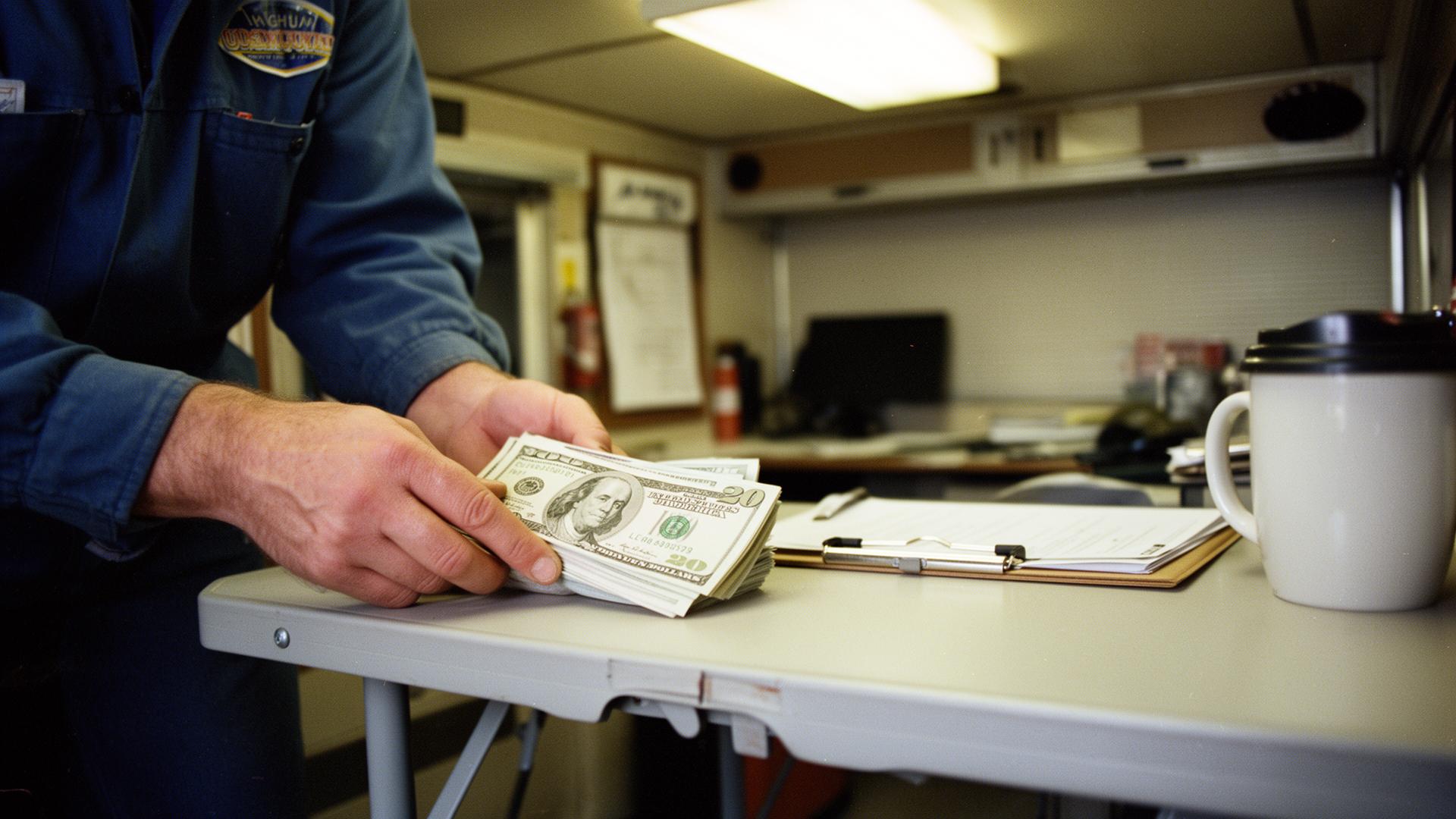
Weathered hands counting a stack of US dollar bills on a wooden picnic table with carnival lights behind
← Carnival Career
The Money

Pay, Bonuses, And What You Keep.

Anyone can quote you a weekly rate. The real question is what hits your bank account after a full season, after expenses, after taxes, after savings. Here is the honest math from green worker to foreman, with the numbers that actually matter and the strategies veterans use to turn a seasonal job into a year of real wealth-building.

01

First-year pay, in real numbers

Green workers on rides start at $500 to $700 a week as a base. On a busy fair with bonuses, that can hit $900 to $1,000. Green workers on games start in the same base range but often clear $1,000 to $1,300 on a strong fair because games pay a percentage of the joint's take on top of base.

Your housing is free. Your utilities are free. Your commute is zero. The cook tent costs $150 to $250 a week. Your phone bill is $40 to $80. Personal expenses run another $50 to $100. That is a sub-$400 weekly cost of living. Even a green worker on a low-pay week is netting $300 to $600 in actual saveable money after expenses, every single week.

02

Year two and beyond

Once you are certified on multiple rides or you have earned a second-man slot, you are looking at $1,000 to $1,500 a week base. Foremen pull $1,800 to $2,400. CDL drivers who also work the show clear $1,500 to $2,000. Bonuses on the big state fairs can add $500 to $2,000 to a single check. By year three, your income has roughly doubled from where you started.

The path to this is not luck. It is taking certifications, showing up reliably, learning a second and third ride, and earning the trust of foremen. The industry is openly short on skilled, reliable workers, which means anyone willing to do the work has a fast track up. There is no degree gatekeeping, no nepotism barrier in most shows, and no salary cap on what a good operator can make.

  • Ride foreman: $1,800–$2,400 per week
  • Game agent on a strong stand: $1,200–$1,800 per week
  • CDL driver plus show work: $1,500–$2,000 per week
  • Big-fair bonus week: +$500–$2,000

03

Real expenses, week by week

Housing: $0. Utilities: $0. Cook tent food: $150 to $250 a week if you eat there for most meals. Phone: $40 to $80. Laundry: $10 to $20 weekly. Personal stuff (toiletries, snacks, occasional restaurant meal): $50 to $100. Total weekly expenses for a careful worker: $250 to $450.

A worker living lean can save $600 to $1,000 of every weekly check during fair season. Try matching that on a $20-an-hour job with rent. The reason carnival workers can build real savings is not because the weekly pay is exceptional — it is because the expenses are so low that almost the entire check stays in your pocket.

04

Annual take-home math

A first-year worker who shows up sober and finishes the season clears $25,000 to $35,000 with almost no living expenses through the work months. A second-year operator clears $40,000 to $55,000. A foreman or strong game agent: $55,000 to $80,000. All from 32 to 38 weeks of work, with another four months to either rest, take a winter side gig, or earn additional income.

Stack a winter warehouse or holiday retail job — even at $400 a week for 10 weeks — and a green worker hits $30,000+ for the year, a veteran hits $60,000+, a foreman hits $85,000+. With no rent paid the entire year. Adjusted for cost of living, this beats most office salaries. The reason most people do not realize this is they have never seen the math laid out honestly.

05

Taxes and self-employment basics

Most carnival workers are W-2 employees of the show, which means taxes are withheld from your weekly check and you get a standard W-2 in January. Some game agents and food workers are paid as 1099 contractors, which means you handle quarterly estimated tax payments yourself and file as self-employed.

Either way, set aside 15 to 25 percent of every check for taxes if you are 1099, or trust your show's withholding if you are W-2. If you are 1099, talk to a tax preparer before April. The savings from deductible business expenses (mileage on a personal vehicle, work boots, tools, phone for business use) can be significant. A $200 tax-prep session can save you $1,000-plus in taxes if you have not been tracking deductions.

I cleared $58,000 last season as a second-year foreman. My only bills were a phone and a truck payment. I bought my mom a car for Christmas and still had savings.

Andre, ride foreman

06

Get paid, keep paid

Open a separate savings account before your first paycheck. Most banks let you do this online in fifteen minutes. Set up an auto-transfer that moves a fixed amount — say $400 or $500 — from your checking to your savings the day after your weekly check is supposed to hit. Live on the rest. Do not touch the savings account during fair season.

The workers who walk away from a season with money in the bank — not just memories — are the ones who automated it from week one. The mental energy of "deciding" each week whether to save is a battle most people lose by week five. Automation removes the decision. You wake up Monday and the money is already where it needs to be.

07

Building credit and banking on the road

A lot of new carnival workers do not have established banking. Fix this in your first month. Open a checking and savings account with any major bank or credit union that has nationwide ATMs. Set up direct deposit with the show so your check lands in your account every Friday with no check-cashing fees eating into it.

Get a credit card and use it for small monthly expenses you will pay off every month — phone bill, gas, cook tent. Pay the full balance every month. This builds credit fast, which matters when you eventually want to finance a truck, an RV, or a house. Workers who finish a few seasons with strong credit and savings are positioned to buy a $30,000 truck-and-trailer setup that pays itself off on the road.

08

What veterans buy with the money

Workers who stay in the industry use carnival money differently than people expect. Common investments: a used pickup truck for personal transportation between spots ($15,000 to $30,000), a used travel trailer for personal housing on the show ($8,000 to $20,000), tools and certifications that increase weekly pay (welding cert, CDL school), education for kids, a down payment on a winter home in Florida or Texas where the show winters.

Some workers buy their own carnival equipment over time — a single game joint runs $20,000 to $80,000, a kiddie ride starts around $40,000, full ride packages start in the low six figures. Owning your own piece of the show is the most reliable path to long-term wealth in this industry, and most owners started as workers who saved diligently for a decade.

09

Avoiding the financial mistakes

The most common money mistakes in this industry are predictable. Spending the whole check the week it comes in. Buying an expensive truck on day one of season one when you have not yet proven you will stay. Burning savings on a long off-season vacation that leaves you broke when spring training starts. Loaning money to bunkmates who will not pay it back. Gambling at off-season casinos.

None of these are unique to carnival workers, but the seasonal income amplifies them. A bad financial decision in fair season can wreck your off-season. Veterans give the same advice: save first, spend later, never lend cash to bunkmates, and treat the off-season as a financial test you have to plan for, not survive.

10

The five-year wealth picture

A green worker who joins the industry, saves disciplined for five seasons, and progresses to foreman by year three or four is realistically looking at $100,000 to $200,000 in liquid savings by year five. That is on top of any vehicle or equipment they bought, any credit they built, and any retirement accounts they opened. The number is not exotic — it is just what happens when you have low expenses and steady income over a few years.

Most office workers in their twenties cannot match that number. They are stuck paying rent, paying student loans, paying for a car, paying for a wardrobe to look professional. Carnival workers skip almost all of those expenses. The math compounds quickly, and by year five a disciplined worker is in a stronger financial position than most of their college-going peers.

The Takeaway

Real money is built by people, not by luck.

Carnival pay is good. Carnival expenses are tiny. The math works for anyone disciplined enough to automate savings and avoid the predictable mistakes. Workers who treat the seasonal income as a wealth-building structure — not a windfall to spend — end up in a stronger financial position in five years than most of their peers in any other industry.

Ready to hit the road?

One 60-second AI interview. No resume. Housing covered.

Apply in 60 Seconds