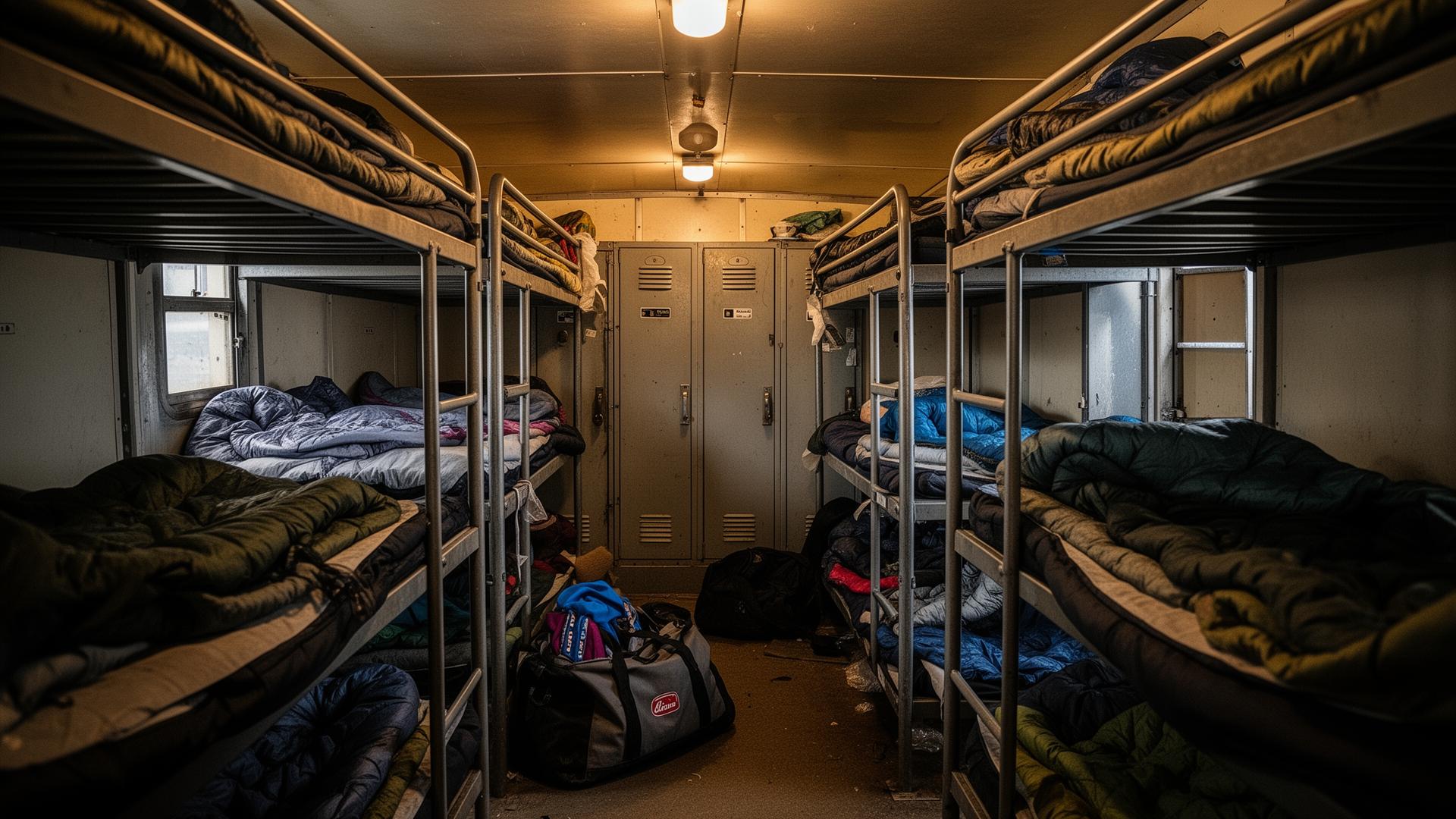
Interior of a carnival bunkhouse trailer with rows of bunks, lockers, and string lights
← Carnival Career
Where You Sleep

Carnival Housing, Honestly.

Every show provides a bed. What that bed looks like depends on the show, your seniority, and how much you are willing to invest in your own setup. Housing is one of the biggest things separating carnival work from any other job in America — your rent is zero, your utilities are zero, and your commute is the walk from your bunk to the midway. Here is the full picture.

01

Bunkhouse trucks — the standard

Most first-year workers sleep in a bunkhouse trailer parked behind the rides. A standard bunkhouse has four to twelve bunks in stacked pairs, a central walkway, individual lockers, air conditioning, and a shared bathroom with a shower at one end. The trailer travels with the show — you pack out Sunday night, ride to the next spot, and your bunk is set up by Tuesday in the new town.

The bed itself is a twin mattress with a vinyl cover. Most workers bring their own sheets and a sleeping bag or comforter. There is a small reading light, a 110v outlet at most bunks, and a vent to the AC system. It is not a hotel room. It is not supposed to be. It is a clean, secure, free place to sleep for eight months a year while you stack money.

02

Lockers, security, and your stuff

Every bunkhouse has individual lockers, one per worker. You bring your own padlock. The lockers hold a duffel bag's worth of gear — clothes, toiletries, electronics, paperwork, anything you do not want sitting on your bunk. Workers store cash in their lockers, in money belts, or in a small portable safe. Theft is rare in established shows because everyone knows everyone, but a padlock is non-negotiable.

You will also want a small canvas or mesh bag for laundry, a power strip with surge protection (multiple outlets near your bunk are gold), a small fan if you sleep hot, and a phone charger with a long cable. Veterans accumulate small comforts — a battery-powered string of lights for their bunk, noise-canceling headphones, a small electric kettle that fits in a locker.

03

Showers and bathrooms

Most bunkhouse trailers have one or two showers on board. They work, but with 8 to 12 workers sharing, you learn to time your shower for off-peak hours — late morning or right before the gates open. Bigger shows often have a separate dedicated shower trailer with multiple stalls, which is a major quality-of-life upgrade.

Many fairgrounds also have public shower facilities for the livestock barn folks and the carnival crew — usually clean, hot, and never crowded. Veteran workers learn the shower situation at every spot on the route. Some prefer truck-stop showers on jump days for a long hot scrub away from the crew. Whatever works.

04

Single-wide trailers — once you've earned it

After a season or two, foremen and long-timers get a private room in a single-wide trailer that travels with the show. Think of it as a tiny apartment on wheels — a real bed, a door that locks, a window, a small dresser, a mini-fridge, sometimes a microwave. Still free, but you have to earn the bump through tenure or promotion.

Privacy is the single biggest quality-of-life upgrade in the carnival industry. Once you have your own room, you sleep better, you decompress better, and you generally last longer in the industry. Most foremen will tell you the move from a shared bunkhouse to a private trailer room is what convinced them they could make a career out of this.

05

Bring your own RV

A lot of veterans pull a fifth-wheel or travel trailer with their own truck. The show parks it for you at every spot, often with free electric and water hookups. You get a real kitchen, a real bed, full privacy, and the ability to keep more than a duffel's worth of belongings. The downside is the cost of the RV itself, the maintenance, the fuel for towing, and the bigger learning curve of backing a trailer.

A used 25-foot travel trailer in decent condition runs $8,000 to $15,000. A used pickup capable of pulling it adds another $15,000 to $30,000. For workers planning to stay in the industry, the RV path pays for itself in two seasons of better sleep, better cooking, and dramatically better quality of life. Many couples on the show live in their RV together year-round.

  • Show provides the parking spot and usually full hookups
  • You pay for the RV, insurance, fuel, and propane
  • Major upgrade if you are staying in the business beyond one season
  • Used 25-foot travel trailers start around $8,000

I haven't paid rent in four years. Every dollar I make is mine. I cannot imagine going back to a $1,400 apartment after this.

Tasha, ride op

06

What's covered, what's not

The bed and a roof are always free. Utilities are always free. Heat in the cold months and AC in the warm months are free, baked into the trailer hookups. Trash pickup is on the show.

What is on you: food, personal toiletries, laundry, phone bill, personal vehicle expenses if you have one, and any upgrades you want to make to your own space (a small heater, a fan, decorations, a personal mini-fridge). Most workers spend $100 to $250 a week on food at the cook tent, maybe another $50 on phone and personal expenses. That is a sub-$300 weekly cost of living. Compare that to anyone paying rent and you can see why workers stay in the industry.

07

Eating on the road

Most fairgrounds have a dedicated cook tent serving the carnival crew. Three meals a day, $5 to $10 a plate, usually hearty American food — eggs and bacon for breakfast, sandwiches for lunch, a hot dinner with a protein and two sides. Cook tents are usually open from 6am to midnight and the food is better than you would expect.

If you want to cook for yourself, the bunkhouses do not have kitchens, but you can keep a small camping stove or hot plate at your bunk, or use the cook tent's outside microwave. Workers with RVs cook their own meals and save serious money over the season. Veterans tend to mix cook-tent meals with their own cooking and the occasional restaurant visit on a day off.

08

Laundry on the road

Most fairgrounds do not have on-site laundry. Workers either find a laundromat in town on their day off, hit a truck-stop washer during the jump, or use a portable laundry setup. Some bigger shows have a dedicated laundry trailer that travels with them, which is a nice perk. A week's worth of work clothes runs about $5 to $10 to wash and dry at a typical laundromat.

Practical tip: bring twice as many socks and underwear as you think you need. Those are the items that wear out fastest and the ones you most want fresh. Outer layers can be re-worn between washes. A dedicated mesh laundry bag with your name on it keeps everything in one place between wash days.

09

Climate, comfort, and seasonal swings

Spring fairs in the Midwest can be 40 degrees and rainy in April. Summer fairs in the South can be 95 degrees and humid in July. Bunkhouses have AC and most have heat, but inside a metal trailer, temperature extremes are real. Veterans bring a small personal fan, a battery-powered hand warmer for early mornings, a sleeping bag rated for the season, and clothing layers they can swap as the weather changes.

By fall the route moves into state fair country and the nights cool down nicely. By the end of October most shows are headed for winter quarters in Florida or Texas, and the weather is finally easy again. The full annual cycle teaches you exactly what gear works in what climate.

10

WiFi, phone, and staying connected

WiFi at fairgrounds ranges from excellent to nonexistent. Some bigger state fairs have full guest WiFi networks. Most county fairs and spot dates have nothing, and you rely on your phone's cellular data. A solid unlimited phone plan is the most important utility you can buy as a road worker. Most veterans use Verizon or T-Mobile for coverage in rural areas.

For workers who need real internet — for video calls home, online classes, streaming entertainment — a cellular hotspot or a phone-as-hotspot setup is the standard. Some workers carry a small wifi router that connects to a hotspot and broadcasts a private network across their bunk or RV. Modern carnival life is way more connected than it was a decade ago.

The Takeaway

Free housing is the secret weapon of this job.

Most American workers pay 30 to 50 percent of their income just to have a roof and utilities. Carnival workers pay zero. That single fact is what makes carnival pay translate into real savings, real bank accounts, and a real path to owning a house or a business of your own one day. The bunkhouse is not glamorous, but it is the financial foundation everything else is built on.

Ready to hit the road?

One 60-second AI interview. No resume. Housing covered.

Apply in 60 Seconds