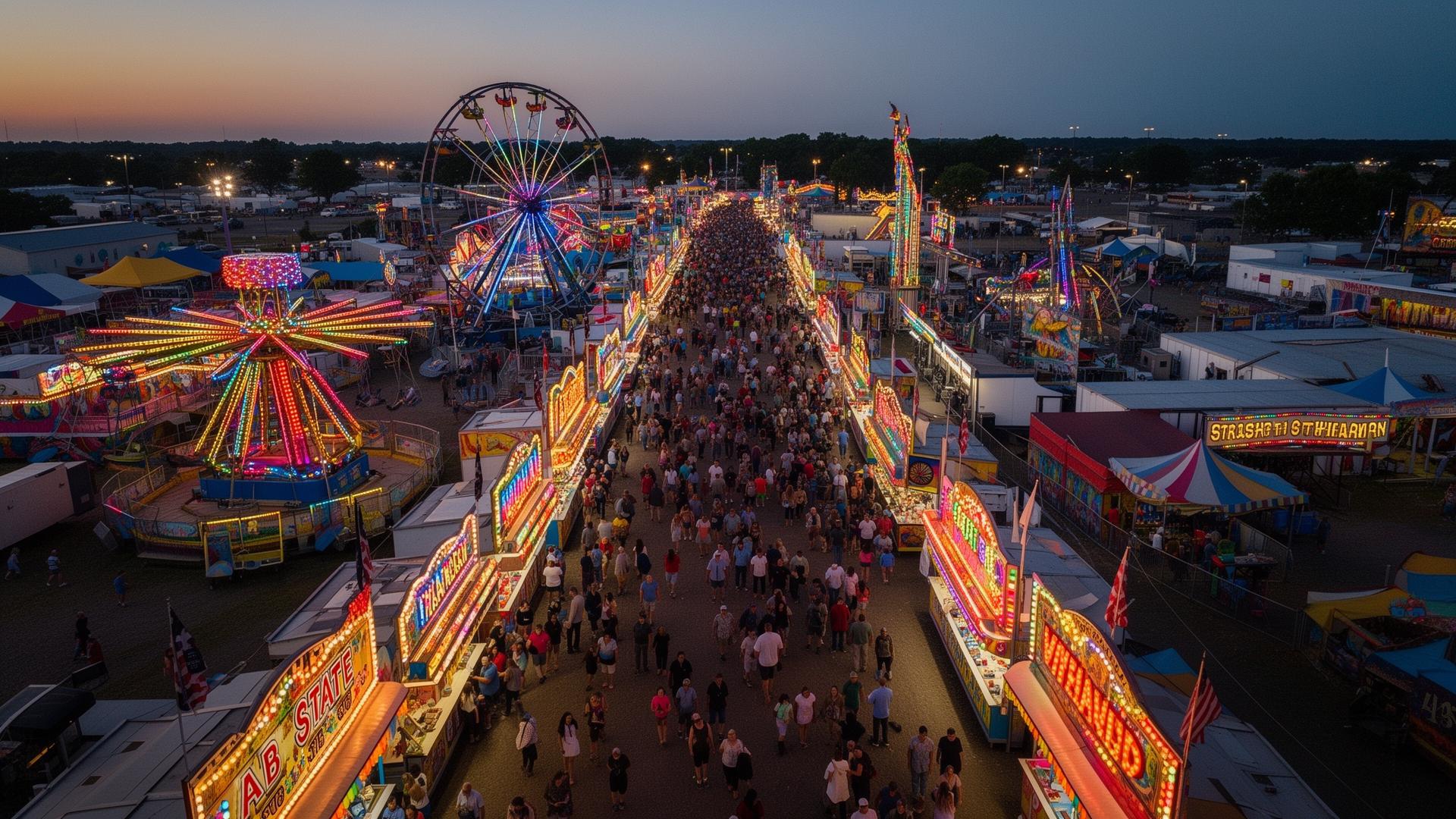
Aerial night view of a packed American state fair midway with a giant red Ferris wheel
← Carnival Career
The Calendar

Spot Dates, County Fairs & State Fairs.

Not every week is the same. A weekend church festival is a different planet from the seventeen-day Minnesota State Fair. Pay varies, crowds vary, intensity varies, food varies. Knowing the rhythm of the fair calendar is what separates a worker who survives a season from one who thrives in it. Here is the full breakdown of what each kind of event looks like and what to expect.

01

Spot dates — the warmup

Spot dates are 3 to 5 day pop-ups in shopping center parking lots, church grounds, small-town festivals, and city celebrations. The setup is smaller — maybe 8 to 15 rides instead of 40, a dozen games instead of fifty, a handful of food stands. Crowds are smaller too, often a few thousand guests across the whole run instead of tens of thousands per day.

Spring is full of them. Most shows use March, April, and May to shake off winter rust on spot dates before the big fairs hit in June. Pay is lower than fair weeks because the percentages are smaller, but the work pressure is also lower. Spot dates are a great place for a new worker to learn the basics without the firehose of a state fair crowd.

02

Church and shopping center festivals

A specific kind of spot date worth mentioning: the church or shopping center festival. These run two to four days, usually a Friday-through-Sunday weekend, on private property owned by a church or a strip mall. The host gets a percentage of the gate or a flat fee. The crowd is heavily families with young kids.

These can be lucrative on a good weekend with great weather — kiddie rides and games are packed, food sells out, and the small crew means each worker's percentage is higher. Veterans like them because they are short, predictable, and usually in nice suburban locations with hotels and restaurants nearby. They are also a softer first week for any new worker.

03

County fairs — the bread and butter

County fairs run 5 to 9 days, almost always in mid-summer. Most shows have a portfolio of 10 to 25 county fairs that make up the core of their season. Crowds vary wildly — a small rural county fair might pull 15,000 guests across the run, while a strong county fair near a population center can pull 80,000 to 200,000.

The vibe is quintessentially American. Livestock barns full of 4-H kids showing cattle and hogs. A grandstand with country music, demolition derbies, or motocross. Local volunteer organizations running gate and parking. Family booths with funnel cake and pulled pork. The midway is the centerpiece of the whole event, and as a carnival worker you are the show.

  • Real fairgrounds with hookups, showers, food infrastructure
  • Strong family crowds — kids on every ride, games every night
  • Local volunteers and 4-H kids make the atmosphere
  • Bonuses kick in for ride crew on good fairs

04

State fairs — the big leagues

State fairs are the biggest paydays of the year. They run 10 to 17 days and pull hundreds of thousands of guests — the Texas State Fair pulls over 2 million across its run, the Minnesota State Fair pulls 1.8 million, the Iowa State Fair pulls about 1 million. The midway is enormous, the rides are the biggest in the industry, and the food alternatives are world-class.

For a worker, state fairs are 17 days of brutal pace and top-dollar checks. You will work harder, longer, and against bigger crowds than any other week of the year. But state-fair weekends are also where bonuses get paid, where percentages compound, and where game agents and ride foremen can clear $2,000 to $3,500 in a single week. They are the financial pillars of every road season.

05

Festivals and themed events

Some shows pick up specialty work outside the standard fair calendar. Mardi Gras in New Orleans, hot-air balloon festivals in New Mexico, Renaissance fairs in Texas, Greek heritage festivals in major cities, harvest festivals, Oktoberfest celebrations. These are wildcard weeks — sometimes packed and lucrative, sometimes slow and disappointing.

The atmosphere at a themed festival is different from a standard fair. The crowd has come for the theme more than the midway, so attendance at rides and games can be lighter than the gate numbers suggest. But food sales are usually strong, and the festivals themselves often pay good guarantees to the show to be there. Workers tend to either love festival weeks (for the different vibe) or count them as a slower paycheck.

Tulsa State Fair, second Saturday — that's the night that pays for my whole winter. Everything else is gravy.

James, 6 seasons on rides

06

The biggest fairs on the US circuit

If you stay in the industry, here are fairs you will hear about constantly: Texas State Fair (Dallas, October), Minnesota State Fair (St. Paul, late August), Iowa State Fair (Des Moines, August), Wisconsin State Fair (Milwaukee, August), Tulsa State Fair (Tulsa, October), South Carolina State Fair (Columbia, October), the Big E (West Springfield Mass, September), Houston Livestock Show and Rodeo (March), San Diego County Fair (June), Erie County Fair (Hamburg NY, August).

Each of these is its own world. Different state regulations, different fairground layouts, different traditional foods, different ride lineups, different crowd dynamics. Veterans who have worked them all develop strong opinions about which is the best worker fair, the best food fair, the most fun fair, and the toughest fair. Half the conversations in any bunkhouse eventually become rankings of state fairs.

07

How pay scales across event types

On a slow spot date, a green worker might clear $600 to $800 for the week. On a strong county fair, that same worker might clear $1,100 to $1,400. On a state fair second Saturday, with overtime and bonuses, a single week can hit $1,800 to $2,200 for a strong second-year operator and $2,800 to $3,500 for a foreman.

This is why veterans plan their season around the state fair weeks. A handful of huge weeks in late summer and early fall make up a disproportionate share of the year's total income. Workers who time their saving and spending to that rhythm end the season with real money. Workers who treat every week the same struggle to make the math work.

08

Weather and how it shapes the week

Fair weeks live and die on weather. A rained-out Friday and Saturday at a county fair can drop attendance by 40 to 60 percent for the whole run, and your weekly check drops with it. A perfect 75-degree weekend with no rain can turn a mediocre fair into a record-setting one. There is nothing you can do about it, but veterans learn to mentally even out the math across the season.

Workers also learn to use bad weather wisely. A washed-out Tuesday is a great time to do laundry, catch up on sleep, get a long meal in town, or call family. Show up Wednesday refreshed instead of grinding through a dead midway. The smart move is reading the forecast Sunday afternoon and planning your week around it.

09

Local infrastructure varies wildly

Big state fairs have everything — paved midways, full electrical hookups, shower trailers, dedicated worker dining halls, on-site medical, parking for personal vehicles. Small county fairs might have a gravel lot, one generator, a porta-john bank, and a single picnic table for cook-tent eating. The full range of working conditions exists across one season.

This is just part of road life. You learn to bring your own comfort items — a folding chair, a small fan, a battery-powered string light, a Yeti water bottle. You also learn to appreciate the fairs with great infrastructure when you get them. Most workers have favorite fairs not just for the crowds but for the showers.

10

Local food, local culture

One of the underrated joys of carnival life: you eat the regional specialty at every fair on your route. Funnel cake in the Midwest. Pulled pork sandwiches at North Carolina fairs. Cheese curds and brats at Wisconsin. Fried Twinkies at Texas. Lobster rolls at the Big E in Massachusetts. Roasted corn at every Iowa fair. Cotton candy and caramel apples everywhere.

You will eat better than most Americans simply because you are eating across the whole map. Workers who lean into this come home from a season with a real palate and a thousand stories. Workers who eat the same cook-tent dinner every night for eight months miss most of the appeal of road life.

The Takeaway

The fair calendar is the rhythm of your year.

Learn the route, learn the rhythm, and treat the big fairs as the financial pillars they are. Workers who plan their year around the calendar — saving during fairs, resting during spot dates, chasing bonuses at state fairs — end the season ahead. Workers who treat every week the same end the season tired and broke. The calendar is the playbook. Run it well.

Ready to hit the road?

One 60-second AI interview. No resume. Housing covered.

Apply in 60 Seconds